
In the Canadian boreal forest, the challenge of post-harvest landscape management is twofold: timber stocking density must be optimized for future yields, and young stands must be protected against catastrophic wildfires.
Enhanced Natural Regeneration (ENR) offers a solution to both challenges. Rather than treating natural broadleaf regeneration as competition to be eliminated, ENR leverages ecological patterns to build strategic biological firebreaks.
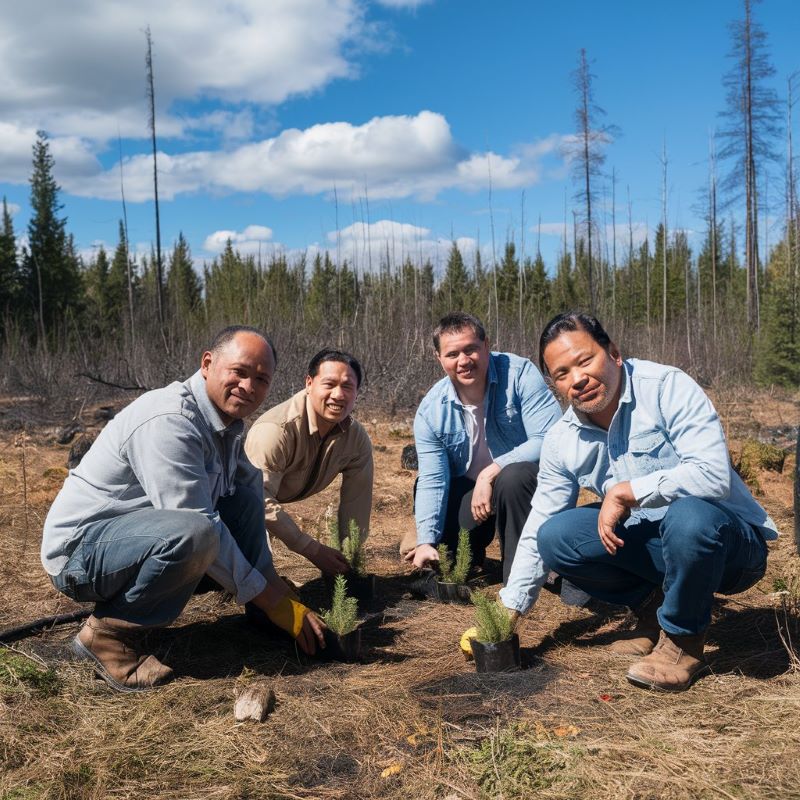
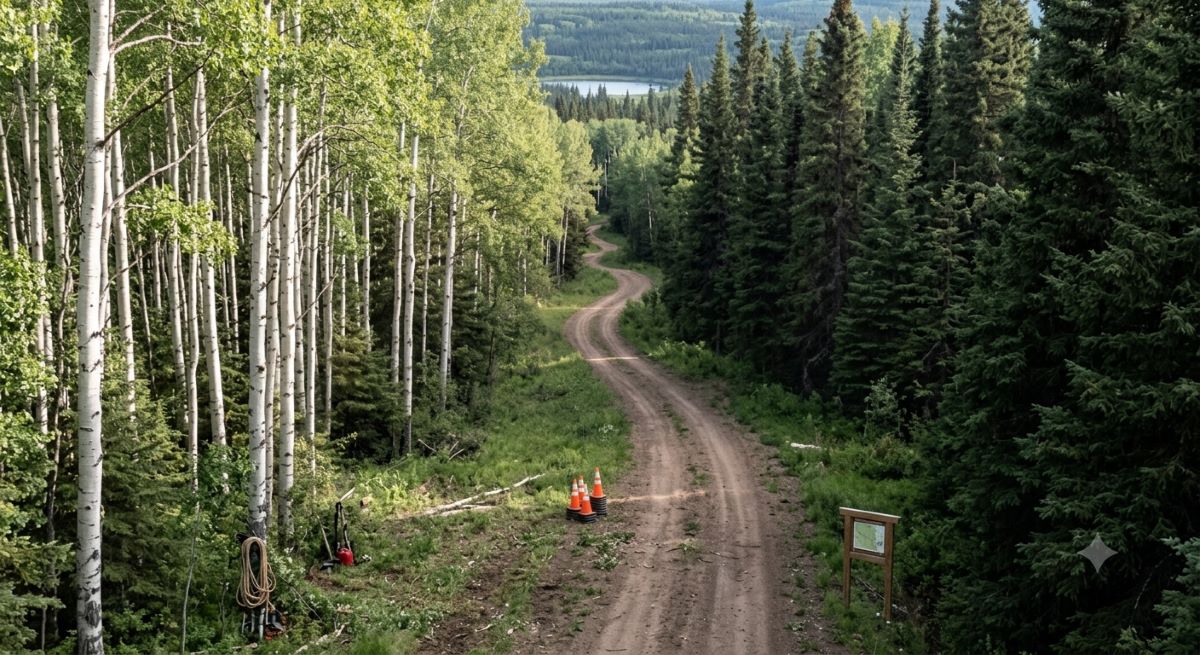
By identifying existing post-harvest broadleaf patches—primarily trembling aspen (Populus tremuloides), white birch (Betula papyrifera), and balsam poplar (Populus balsamifera)—transplant crews connect these patches into a continuous, broadleaf-dominated buffer at least 30 meters wide across the cutover. Conifers within this corridor are transplanted outward into dedicated timber zones, while deciduous saplings are moved into the firebreak.
Below is the scientific, economic, and ecological foundation behind the ENR approach.
1. The Physics and Biology of Deciduous Firebreaks
Deciduous stands in the boreal forest have long been recognized as natural fuelbreaks. When a high-intensity conifer crown fire encounters a broadleaf stand, its behavior changes dramatically—often dropping from an explosive canopy fire down to a manageable, low-intensity surface fire.
High Foliar Moisture Content and Seasonal Dynamics
Coniferous species such as black spruce (Picea mariana) and jack pine (Pinus banksiana) contain volatile resins, terpenes, and low foliar moisture during peak fire weather. In contrast, broadleaf species carry significantly higher foliar moisture levels throughout the summer growing season. Water’s high specific heat capacity means that incoming wildfire energy is consumed vaporizing leaf moisture rather than igniting the canopy.
Absence of Ladder Fuels and Higher Canopy Base Height
Crown fires require continuous vertical fuels—known as “ladder fuels”—to climb from the forest floor into the tree canopy. Broadleaf trees naturally self-prune their lower branches as they grow, maintaining a high canopy base height. Paired with smooth, non-flammable bark, broadleaf stems offer few pathways for surface fires to ascend.
Microclimate Modifications
Dense broadleaf canopies shade the forest floor, maintaining higher relative humidity and lower surface wind speeds compared to open or conifer-dominated stands. This cool, humid microclimate significantly slows the rate of spread (ROS) of surface fires.
Key Takeaway: A 30-meter broadleaf corridor acts as a physical thermal sink and fuel discontinuity, forcing advancing crown fires to lose momentum and transition to low-severity surface burning.
2. Economic Efficiency: Why ENR Outperforms Traditional Reforestation
Traditional silviculture often relies on heavy herbicide applications or mechanical clearing to suppress broadleaf “brush,” followed by high-density conifer planting. ENR flips this model by utilizing existing biological assets already on-site.
| Feature | Traditional Silviculture | Enhanced Natural Regeneration (ENR) |
| Material Costs | High (nursery stock purchase) | Low (utilizes existing natural saplings) |
| Chemical/Mechanical Clearing | High (frequent herbicide spray) | Minimal (strategic micro-transplanting) |
| Stem Density Optimization | Uniform across block | Targeted (maximized conifer density in production zones) |
| Fire Suppression Infrastructure | Built post-facto or absent | Integrated (30m firebreak engineered during stocking) |
Lower Capital Outlay
Transplanting naturally established saplings eliminates the overhead of purchasing nursery-regrown stock and minimizes transport logistics. The primary input is targeted manual labor during the early regeneration phase.
Dual-Zone Maximization
By relocating conifers out of the designated 30m firebreak corridor and into adjacent production zones, ENR increases conifer stem density (stems/ha) where timber yield matters most, while simultaneously establishing a functional fire protection asset.
3. Alignment with Natural Boreal Ecology
The boreal forest is historically a fire-driven ecosystem characterized by dynamic spatial patchiness. ENR aligns directly with these ecological evolutionary pathways rather than fighting them.
- Emulating Natural Mixedwood Disturbance: Natural boreal landscapes are rarely homogenous; they are mosaics of conifers, mixedwoods, and hardwood patches created by varying fire severities. ENR creates structured spatial heterogeneity that mimics natural successional dynamics.
- Carbon and Nutrient Cycling: Research shows that post-fire or post-harvest broadleaf stands accumulate biomass and retain key soil nutrients (such as nitrogen) rapidly. Broadleaf leaf litter decomposes faster than conifer needles, improving soil fertility across the block.
- Landscape Biodiversity and Climate Resilience: Broadleaf corridors serve as biodiversity highways for avian species, small mammals, and soil fauna. Furthermore, broadleaf forests store carbon stably with lower combustion losses during wildfire events compared to pure conifer stands.
Scientific Literature & References
Nesbit, K. A. (2023). Evaluating Quaking Aspen’s Influence on Fire Behavior. Utah State University Digital Commons.
Black, B., Walker, X. J., Berner, L. T., et al. (2026). Increased deciduous tree dominance reduces wildfire carbon losses in boreal forests. Nature Climate Change, 16(2), 187–192.
Cumming, S. G. (2001). Forest type and natural fire intervals in boreal Canada. Ecology, 82(5), 1420–1430.
Hirsch, K. G., Kafka, V. N., Tymstra, C., et al. (2001). Fire operations in the boreal forest: Managing fire hazard with fuel management techniques. The Forestry Chronicle, 77(2), 357–367.
Johnstone, J. F., Chapin, F. S., et al. (2011). Prime drivers of forest resilience in the boreal ecosystem. FES, 11(2), 121–129.
Mack, M. C., Walker, X. J., Johnstone, J. F., et al. (2021). Deciduous tree expansion in native boreal forest offsets carbon loss from severe fires. Science, 372(6539), 280–283.